It's been a while since I updated my commercial reel and I've had several fun projects this year. See if you can count how many types of animation there are! Post your count in the comments below or tweet it to me @corriefrancis and I'll choose one of the correct answers for an extra special prize!

Monday, September 27, 2010


Monday, September 13, 2010
Shelly
A beach full of shells is an inspiring place, even on a gray and rainy afternoon. Nothing like a bit of plein air animation to spice up a romantic walk. Mr. Parks double as tripod and remote trigger for me. The whole thing took about 7 minutes to film. If it was a brilliant, warm sunny day, this piece might have been a bit longer.
Thursday, August 5, 2010
Upcoming Photography Lecture!
If you are in Wanaka, take note! I’ll be presenting some of my work to the Wanaka Photography Club this Monday, August 9 at 7:30pm. 


Wednesday, August 4, 2010
Promoting Good Animation: Accumulonimbus
Accumulonimbus from andy kennedy on Vimeo.
It's great when you see an animated film that could not have been done in any other medium than the one chosen. This is pretty awesome use of clay, bringing together the sculpting craft of an Aardman or Vinton with rhythm and repetition of the masters of abstraction. Watch it big if you can and revel in the details! Thanks to Tiny Inventions for tweeting this so I could find it!
Wednesday, July 7, 2010
Promoting Good Animation! New work from BLU
Hard to go wrong with BLU. This time he's gone more 3 dimensional, swallowing anything lying around on the streets into the animation. My favorite part is the trash can hermit crab.
Sunday, July 4, 2010
Notes from the Animation Workshop at NZMFF
Animation is creating movement frame by frame. The thing that makes animation easy these days is you can take any sequence of frames (drawings, photographs etc) recorded with a digital camera or frame capture program and import it into just about any editing program (iMovie, Windows MovieMaker, Adobe Premier, Final Cut) and cut it into your live action footage.
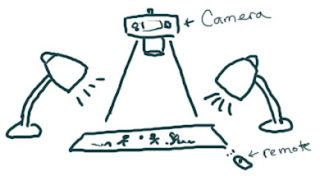
To shoot your own animation, you'll need a basic animation set-up. This can be as simple as a digital camera on a tripod pointed at a flat surface with two lights on either side. You can get fancier from there by building your own camera stand, using special lighting techniques, frame capture programs and more. You will want to make sure your camera doesn't wiggle when you take frames so be sure to use a remote or cable.
So now that you're set-up, let's make some animation!
If you are artistically inclined, you can animate up a storm on paper. I won't start on the principles of hand-drawn animation here. There are dozens of sites on the web and books in the bookstore that will teach you the principles of character animation. Good drawing skills don't make up for poor character and story development. You can move an audience to tears with a stick figure, but a fancy, moving drawing that doesn't have heart and life behind it will only get you brief admiration.
Once you have your stack of drawings, all you need to do is put each one under the camera and click, click, click. Then either download the frames from your camera or animation program and import it into your editing program and you are good to go. Here's a great example of hand drawn animation in the introduction to The Fine Line.
Paper Shredders from Rocky Mountain Sherpas on Vimeo.
But not everyone is the next Glen Keane. Never fear, for the drawing impaired there are other forms of animation. Stopmotion is taking an inanimate object and giving it life through animation. You can use anything from paper cut outs, household objects, lollies, or anything you can get your hands on including people!
Now comes the part where you want to be at the workshop. I will demonstrate some animation basics of stopmotion, including how to control the speed and fluidity of your animation, using replacement animation, cycles and morphing.
The best way to learn about animation (apart from doing it yourself) is to watch other animation and figure out how it's done. Watch some of this great stopmotion animation by Pes and see if you can pick out some of the techniques we talked about in the workshop.
Between drawing and stopmotion, you pretty much have all forms of animation covered. These principles extend into all techniques, claymation, puppet animation, even 3-d animation. It just takes a little experimenting to find the technique that's right for your production!
Where to from here?
Want to learn more about animation?
Here's a list of books to get you started.
Animation Arena has a lot of articles about creating good animation.
Animation Tips and Tricks is a blog for aspiring animators.
Curious about more styles of animation? Here are some of my favorites on Youtube.
Thanks for coming and making the workshop a success! Happy animating!
Thursday, July 1, 2010
Animation Secrets revealed at NZMFF
I am the world's biggest fan of creative use of animation and thrilled to see it permeating every film, documentary, music video and commercial that rolls out into the mainstream theses days. Thank you digital media for making it easy (well, easier) to animate!
This Sunday, I'll be hosting a workshop at the New Zealand Mountain Film Festival in Wanaka. If you happen to be in town, come to the Lake Wanaka Centre at 10am on Sunday morning. If not, or if you come and don't want to take notes, check back on the blog. I'll be posting an outline and some links after the workshop. Don't think you can skip the workshop though. I'll do some live demonstrations and show some handy tricks that I can't post in the blog!
By way of introduction, check out the festival's 2007 winner of the Best Film on Mountain Culture and Environment, "Conversing with Aotearoa/New Zealand". What does animation bring to a film production anyway? Why should we even bother with it?
Watch more free documentaries
Watch more free documentaries

From there we'll talk about how to animate drawings, paper cut outs, inanimate objects, or anything you can get your hands on including people! Just for fun, here's an awesome music video by Oren Lavie and Yurval and Merav Nathan.
Looking forward to seeing you at the festival!
Subscribe to:
Posts (Atom)